




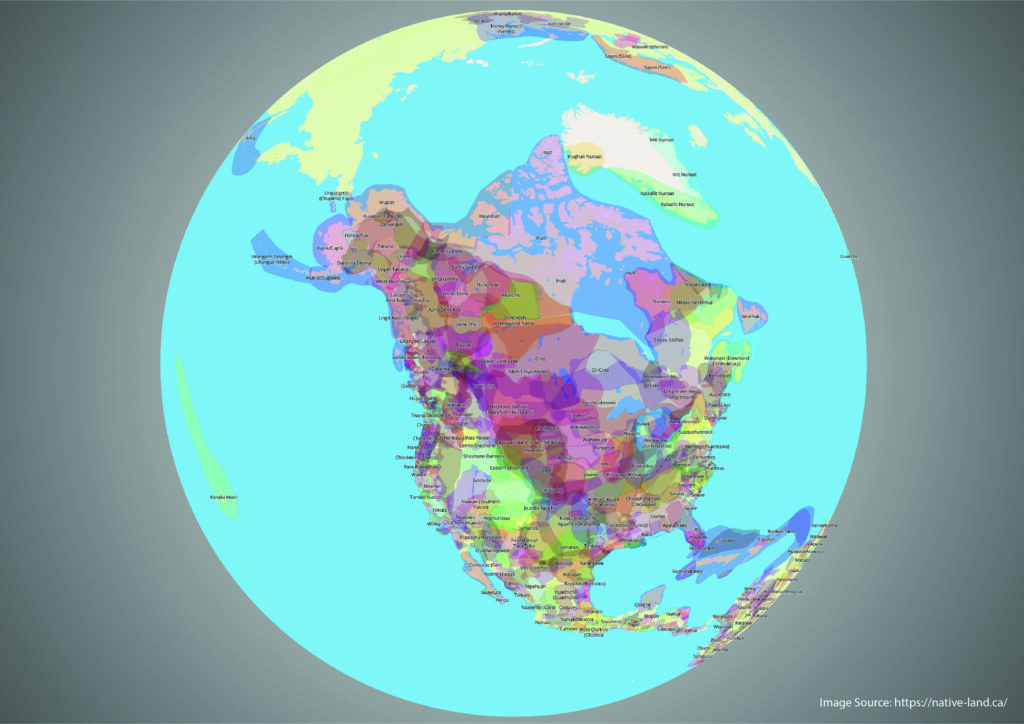
Territory acknowledgements are a way to honour the Indigenous Peoples who have longstanding ties to the land where we gather. They are rooted in Indigenous protocols for gathering and can be one way to show a commitment to reconciliation.
An acknowledgement can be simple when you are starting out. Learn whose territory you are on, use their names accurately, and take time to understand the words you are saying.
As you learn more, you can make your acknowledgement more personal and connect it to the work you do on the land. Some people choose to take that reflection further, speaking to reconciliation, colonialism or anti-racism.
First, learn whose territory you are on
Before preparing an acknowledgement, find out which Nations have connections to the place where you will be speaking. Resources such as Whose Land and the First Peoples’ Map of B.C. can help you begin. Then check the Nations’ own websites or other local Indigenous sources for the names, spelling, pronunciation, and wording they use.
If your organization works in more than one location, a single acknowledgement may not fit every gathering. For an online meeting, the host can acknowledge the territory they are joining from and recognize that others may be joining from different territories.
A simple land acknowledgement example
If you are new to this, it is okay to prepare your words and read them. Your organization may already have approved wording you can use. If it does not, here is a starting structure to adapt:
“I’d like to begin by acknowledging that we are meeting on the [appropriate description] territory of [Nation or Nations] and am grateful for the opportunity to gather here.”
Before using it, confirm the Nations and the appropriate description of the territory and practice saying the names aloud so you can deliver the acknowledgement at a natural pace.
A written land acknowledgement example
Organizations may also include an acknowledgement on their website, in a report, or in other materials. A written version can also recognize where the organization is based while making room for team members who may work elsewhere. For example:
“[Organization] acknowledges that our team members live, learn and work on traditional and unceded lands from coast to coast. Our main office is located on the unceded territory of the Coast Salish peoples, including the territories of the xʷməθkwəy̓əm (Musqueam), Skwxwú7mesh (Squamish) Nations and Səl̓ílwətaʔ/Selilwitulh (Tsleil-Waututh). We are grateful for the privilege of being on this land and acknowledge the resilience and continued stewardship of the traditional peoples.”
How to make your acknowledgement more personal
Len Pierre Consulting’s Transformative Territory Acknowledgement Guide describes a progression from a standard, prepared acknowledgement to more reflective and ultimately transformational one. A reflective acknowledgement keeps the accurate identification of the territory while adding something in your own voice, often using an “I” statement.
You do not need to answer all of these questions aloud, but they can help you find a genuine connection:
- What does giving this acknowledgement mean to me?
- Why is it meaningful for my organization or profession to acknowledge this territory?
- How does it connect to the purpose of this meeting or the work we do here?
- What have I learned about the Nations I am acknowledging that I can share accurately?
One thoughtful addition is enough. It might be something you have learned or an experience that has changed how you think about the place where you work.
Connect the acknowledgement to your work
As you become more familiar with the process, consider why acknowledging the territory matters to the work you are doing. Doctors of BC offers an example that connects its acknowledgement to its responsibilities as an organization. Here is an example adapted from Doctors of BC’s:
“We begin by acknowledging that this gathering is taking place on the traditional territory of [Nation or Nations], whose relationship with this land continues today. At Doctors of BC, acknowledging the territory is part of approaching our work with cultural humility and recognizing our responsibility to provide culturally safe care to First Nations, Inuit, and Métis people in BC.”
The connection will be different for every organization. A school might reflect on how it teaches local history. A community organization might consider how it builds relationships with the people it serves. A business might think about how its decisions affect the communities where it operates.
The aim is to say something that is relevant to your work and true to what you are learning. You can begin with approved wording, make it your own over time, and update it as your understanding grows.
Keep learning
There is no single acknowledgement that works for every person, place, or occasion. Stay open to feedback and new information. As you practice, look for ways to move beyond familiar wording and make your acknowledgement more personal and relevant to the gathering. Most of all, keep learning about the Nations you acknowledge after the meeting ends; reconciliation is an ongoing process, not an event.
For ideas on continuing that work in your organization, explore:
- Guide: “Honoring Truth and Reconciliation in the Workplace”
- Article & Webinar: “Staying in Reconciliation”