



If we want healthier communities, stronger workplaces, and more connected families, we need a more inclusive conversation. One that acknowledges both privilege and pain, responsibility and support.
Here are three shifts that can help us move forward.
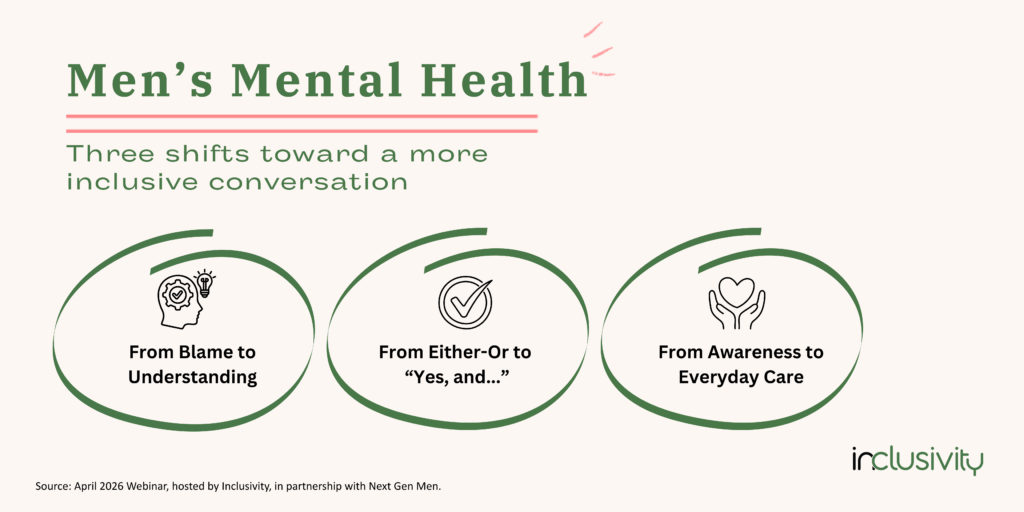
Shift 1: From Blame to Understanding
One of the most important reframes is understanding that the same systems that advantage men can also harm them. Within cultures that often reward traditional masculinity, many boys and men also experience pressure to suppress emotion, avoid help-seeking, and carry expectations around strength and independence.
This complexity is reflected in the data. Men account for the majority of suicide deaths globally, are less likely to seek mental health support, and often experience poorer health outcomes overall. These realities point to a gap between expectations and the support available to men.
As Jake Stika, Executive Director of Next Gen Men, notes, “Within the same system that privileges men, we’re also seeing that 3 of 4 suicides are men. Men die, on average, 4 to 5 years earlier than women. In general, men have worse health and help-seeking behaviors.”
Men may benefit from systems in some ways, while also experiencing real challenges in others. When we ignore that complexity, conversations become polarized but when we acknowledge it, we create space for shared responsibility.
Supporting boys and men is not in conflict with advancing equity. It is an important part of building healthier communities for everyone.
Shift 2: From Either-Or to “Yes, And”
Many conversations about gender fall into binary thinking. Supporting women or supporting men. Addressing privilege or addressing wellbeing, accountability or empathy etc. But real progress rarely happens in binaries and it’s important to remember that we can hold multiple truths at once. For example:
- Men can benefit from systems of power and still struggle
- Gender inequities can exist while boys and men face real mental health challenges
- We can continue advancing equity while ensuring boys and men feel included.
This more nuanced thinking reduces defensiveness and invites engagement. When people feel blamed, they disengage, and when they feel included, they participate.
This matters because there is a growing gap between crisis and care, creating what Stika described as “fertile ground for radicalization, polarization, and narratives that are tearing us apart.”
A more inclusive conversation helps fill that gap. It offers connection instead of division and understanding instead of blame.
Shift 3: From Crisis Awareness to Everyday Care
The statistics around men’s mental health are troubling, but awareness alone is not enough. The real opportunity lies in how we respond.
Many men are struggling with depression, anxiety, fear, and insecurity long before reaching extreme outcomes, yet many do not seek help. Cultural expectations around masculinity often discourage vulnerability and emotional expression, making it harder for men to access support early.
This is where empathy and everyday care matter. When boys and men experience empathy, they build the capacity to extend it to others. When they feel seen and supported, they become more open to growth, connection, and wellbeing.
Creating this environment is closely tied to psychological safety. When people feel safe to speak honestly, express emotion, and ask for help without fear of judgment, they are more likely to engage and support one another. In workplaces, psychological safety has been linked to stronger team performance, greater inclusion, and improved wellbeing.
Small everyday type actions, founded in care and compassion, can make a meaningful difference:
- Creating space for open conversations
- Modelling vulnerability and care
- Challenging restrictive norms
- Encouraging connection and belonging
- Asking better questions and listening without judgment
These actions do not require expertise. They require intention, empathy, and a willingness to show up.
A Better Way Forward
When we shift from blame to understanding, from either-or to yes-and, and from crisis awareness to everyday care, we create a more inclusive conversation about masculinity and mental health. One that reduces polarization, strengthens connection, and supports boys and men while continuing to advance equity for everyone.
We do not need to have all the answers to begin. Small moments of empathy, inclusion, and care can have a meaningful impact. As Jake Stika shared, “Start where you are, use what you have, and do what you can. You don’t need to be an expert. Just showing and practicing care can be transformative.”
Looking to support mental health and psychological safety in your workplace? Inclusivity offers practical, research-informed training to help organizations.
Subscribe to the Next Gen Men newsletter for weekly insights, tools, events, and resources designed to engage, educate, and empower boys and men, and those who support them