





An employee survey can tell you that most people feel supported at work, while also leaving you wondering whose experiences are missing from that picture.
Collecting employee demographic data helps organizations understand how experiences and opportunities vary across their workforce. Looking at survey responses alongside demographic information can reveal concerns that are less visible in an overall score, including differences in access to professional development or confidence in leadership.
Before launching an employee demographic survey or adding questions to an existing one, consider the following five questions.
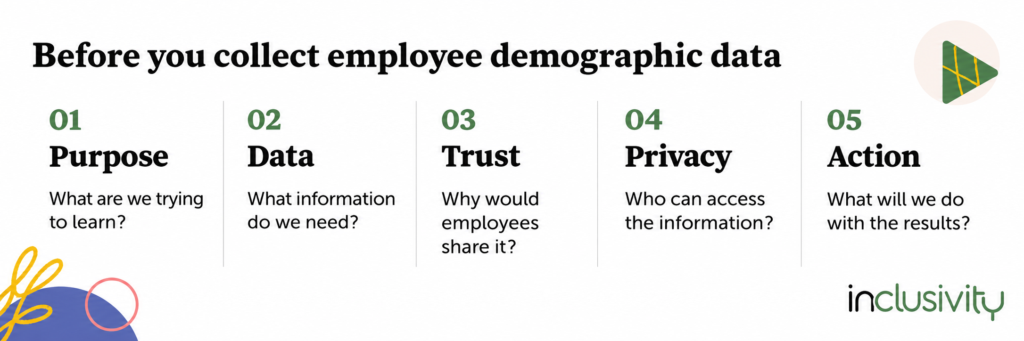
1. Purpose: What are we trying to learn?
Start by identifying the questions your organization needs to answer. You may want to understand why employees are leaving a particular department or whether people have equitable access to advancement.
A clear purpose helps you decide what to ask and gives employees a meaningful reason to participate. It also helps secure leadership support by connecting the work to an organizational priority.
For example, if you are concerned about retention, consider where the uncertainty lies. Are employees leaving early in their careers? Does turnover vary across demographic groups? What do you already know from exit feedback?
We’re not suggesting you need to predict the findings, but you do need enough clarity to explain why you are collecting the information and how it could inform your decisions.
2. Data: What information do we actually need?
Once the purpose is clear, consider what information will help answer your questions, including data your organization already holds. Each survey question should have a clear purpose.
In our work with organizations, we often see the same survey repeated year after year because it provides a familiar benchmark. Tracking results over time can be valuable, but only if the questions still address what you need to understand. Before carrying a question forward or borrowing one from another organization, ask what the answer will help you decide.
Demographic information provides context about who is in your workforce. Looking at it alongside employee experience questions can help you understand whether people experience the workplace differently.
Consider a hypothetical survey in which 78% of employees agree they have equitable access to development opportunities. That result may seem encouraging. A closer look might show agreement at 84% among one group and 62% among another.
This is the value of disaggregated employee data: examining results by relevant groups can reveal differences hidden within an overall average.
Choose demographic questions that serve your purpose and that you can use responsibly. Asking about every possible dimension of identity can create unnecessary burden and leave employees wondering why so much personal information is needed. Use respectful language and allow multiple selections where appropriate.
3. Trust: Why would employees feel comfortable sharing it?
An invitation to complete a survey asks people to place trust in the organization. Their willingness to participate will reflect their experiences at work, including how leaders have responded to concerns in the past.
A large study of employees from underrepresented groups found that trust in the organization and supervisors helped explain employees’ willingness to disclose their identities at work. As the researchers noted, “in organizations where policies and practices generate trust, employees are more willing to disclose their identity.”
Consider the survey from an employee’s perspective. Would you understand why the information is being collected? Would you know whether your manager could see your answers? Would you feel comfortable declining a question?
- Explain the purpose before the survey launches.
- Make participation expectations clear, and provide a “prefer not to answer” option for demographic questions.
- Give employees a contact for questions
Employees also need a realistic understanding of what will happen afterwards. You may be able to commit to sharing findings and developing an action plan without knowing yet what specific changes will be needed.
Keep those commitments within reach. Following through on a modest promise gives people a reason to trust the next request for their input.
4. Privacy: Who will have access to the information?
Privacy is a priority when collecting employee demographic data, but employees need more than a general assurance that their answers are confidential. They want to understand who can see their responses and whether the details they share could identify them.
That confidence cannot be assumed. Gallup’s 2026 research found that only 20% of employees who regularly use a computer or device have “a great deal” of trust in their leaders to use employee data responsibly.
Before launching a survey, explain who can access individual answers and how results will be reported to protect people’s identities. Give employees the option to decline demographic questions and a contact for privacy concerns.
Be equally clear about follow-through. If previous surveys produced little visible change, explain what will be different this time and when employees can expect to hear about findings and next steps.
5. Action: What will happen once we have the results?
A difference in survey results alone cannot establish its cause. It can point you toward an issue that needs closer investigation.
For example, if employees with disabilities report feeling less comfortable speaking up, you might consider training your managers to invite feedback. Further investigation could reveal that employees have raised concerns before and received no response, or that the available feedback channels are inaccessible. Understanding their experiences helps you choose an approach that addresses the underlying issue.
Use the findings to develop questions you can investigate through follow-up conversations and a review of relevant workplace practices. Consider whose voices may be missing from the survey, too. A strong overall response rate can still leave some groups underrepresented.
Before launch, make sure leaders have committed time and resources to this work and when you’re ready to share findings with employees, explain
- what you have learned,
- where questions remain,
- what happens next.
Continue to share updates on actions taken and progress made – employees expect and appreciate knowing their feedback is informing decisions and contributing to improvements in the workplace.
Planning your next employee survey
Whether you are introducing demographic questions for the first time or reviewing an existing survey, use these five questions to identify where your approach needs more attention. Resolving those gaps before launch can help you gather more useful information and give employees greater confidence in the process.
Inclusivity supports organizations with employee surveys and analysis to help them understand workplace experiences and identify priorities for action. Explore our workplace assessments or connect with us at hello@inclusivityinsight.com to discuss your goals.
This article is based on a webinar “Collecting People Data: What Organizations Need to Know”, with Inclusivity’s Wyle Baoween and Sara Hamelin, October 2026.