




AI is rapidly transforming how work gets done, but technology alone does not determine success. Organizations that invest in leadership development and workplace culture are better positioned to adopt AI thoughtfully, support people through change, and sustain innovation and performance over time.
Artificial intelligence is already reshaping how work gets done. What is becoming increasingly clear, however, is that technology itself is not what separates organizations that thrive from those that struggle. The real differentiators are leadership development and workplace culture.
As AI adoption accelerates, organizations are discovering that tools alone do not drive positive outcomes. Leadership skills, decision-making norms, psychological safety, and general workplace culture shape whether AI builds trust, improves performance, and supports people, or creates confusion, resistance, and unintended harm.
In the AI era, transformation is not primarily a technical challenge, it’s a leadership and cultural change challenge.
Did You Know?
- 800 million weekly active users globally
- 28% of US Employees actively use ChatGPT at work
- 92% of fortune 500 companies have adopted AI tools
- 66% of AI writing tasks are editing/refining existing work, not creating from scratch – people use AI to augment, not replace their work.
Source: The State of Enterprise AI
Building a Workplace Culture That Keeps Pace With AI Adoption
In many workplaces, AI use is already widespread, even when leaders believe their organization is still at an early stage. Employees are using AI to write, analyze, summarize, and automate tasks, often without formal training or clear expectations. This has created a common gap, where new tools are introduced faster than organizations can put the right structures and guidance in place.
Without clear workplace practices, policies, and leadership direction, employees are left to make individual judgment calls about how and when to use AI. Over time, this can lead to inconsistent approaches, uncertainty, and unintended consequences, even when intentions are positive.
Organizations that approach AI through a workplace culture lens are better positioned to respond, not because culture dictates technology use, but because culture shapes how change is navigated. Workplaces that have invested in trust, learning, and open communication are better able to introduce new tools thoughtfully, surface concerns early, and adjust as they learn.
In this context, workplace culture supports adaptability. It influences whether people feel safe asking questions, sharing feedback, and engaging with change in a constructive way. Combined with clear structures and practices, this creates the conditions for AI adoption that is intentional, aligned, and sustainable.
Leadership Skills Required to Lead Successful AI Transformation
AI transformation is often framed as a technical shift, but in practice it is a leadership development challenge. Leaders are being asked to guide teams through uncertainty while learning alongside them. This requires a different set of leadership skills than many traditional leadership development training programs emphasize. Leaders need to balance clarity with curiosity, direction with listening, and confidence with humility.
Leadership development becomes a differentiator in the AI era because technology changes faster than people’s ability to adapt. Leaders who have not developed the skills to lead through ambiguity, ethical tension, and rapid change will struggle, regardless of how advanced the tools are.
In the absence of clear leadership, AI adoption tends to become fragmented. Some teams move quickly, others hesitate, and inequities widen between those with access, confidence, or informal permission to experiment and those without.
Leadership development training for AI transformation focuses on helping leaders:
- Set clear expectations without pretending to have all the answers
- Make values-based decisions about how AI is used
- Recognize where AI may reinforce bias or exclusion
- Stay accountable for outcomes that affect people, not just performance
This is not about becoming an AI expert, it’s about developing leadership capability in moments of rapid change.
Psychological Safety Is Not Optional in the AI Era
Psychological safety plays a critical role in how organizations experience AI transformation. When employees feel safe to ask questions, name concerns, and admit uncertainty, learning accelerates. When psychological safety is low, AI can quickly become a source of fear, secrecy, or competition.
In workplaces where people worry about being replaced, monitored, or judged for how they use technology, innovation slows and trust erodes. Whereas, leaders who prioritize psychological safety create space for experimentation while reinforcing shared responsibility.
This is especially important for organizations investing in leadership development. Leaders who model openness, invite dialogue, and normalize learning curves help teams adapt together rather than in isolation.
Psychological safety allows organizations to learn in real time, rather than react after harm has occurred.
Leadership and Workplace Culture Will Shape the Future of AI Adoption
AI transformation is not a one-time initiative. It is an ongoing test of leadership development, workplace culture, and organizational readiness.
While some organizations worry that governance will slow innovation, clear guidance often enables it. When leadership sets expectations around acceptable use, accountability, and learning, teams are better able to experiment with confidence.
In practice, successful AI adoption depends on:
- Leadership that provides clarity without shutting down learning
- Workplace culture that supports trust, adaptability, and open dialogue
- Governance that evolves as tools, risks, and understanding change
- Leadership development that prepares leaders to guide people through uncertainty
In a landscape where similar technologies are widely available, competitive advantage no longer comes from the tools themselves. It comes from how leaders support people through change and how workplace culture enables learning and responsibility.
AI will continue to evolve. Leadership and workplace culture will shape what it becomes inside the workplace.
Leading AI Transformation in Your Workplace
Would your organization benefit from leadership development training or AI implementation and change management support? Learn more, and reach out to see how the teams at VitalAI and Inclusivity can support:
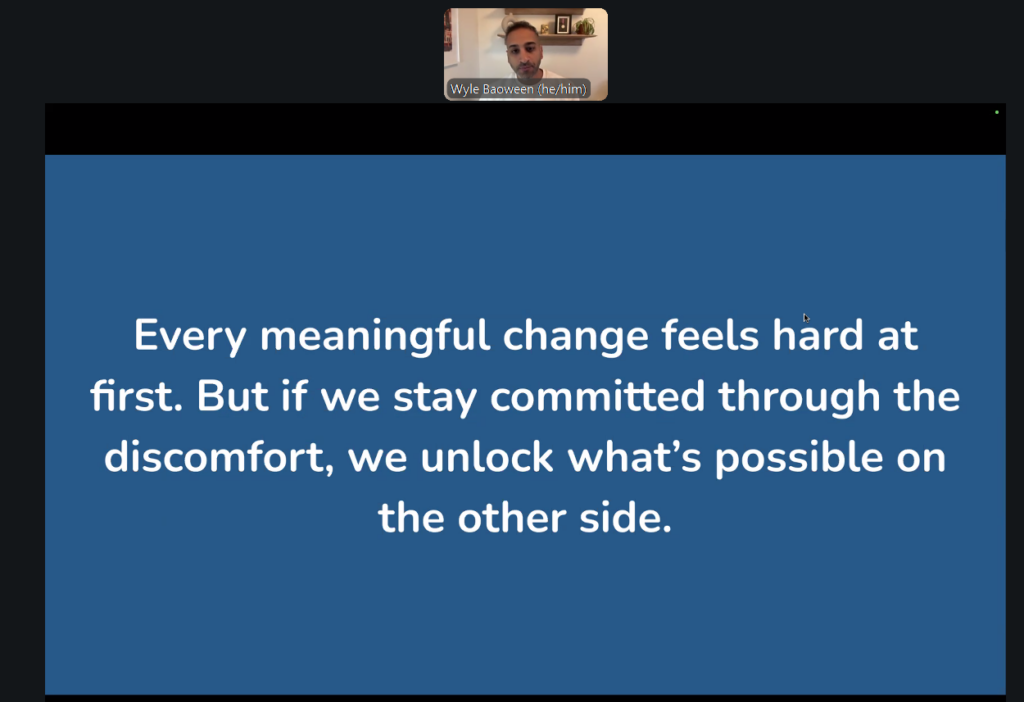
This article is based on the webinar “Leading AI Transformation” hosted by VitalAI in partnership with Inclusivity in December 2025. Thank you to Wyle Baoween and Heather Lefebvre of VitalAI for their guidance and insights.