




Workplace Culture Trends in 2026 show that performance will depend on how well organizations strengthen middle management capacity, lead AI transformation, and build resilient, agile teams within a strong workplace culture grounded in psychological safety.
Organizations are entering 2026 in a climate defined by sustained pressure and accelerated change. Economic uncertainty, rapid advances in AI, evolving workforce expectations, and persistent capacity constraints are reshaping how work is structured and delivered. What once felt cyclical now feels constant, placing new demands on workplace culture and leadership.
As one leader noted, teams are navigating “frequent policy changes, technology upgrades, and evolving models while already managing high stress and workload pressures.”
Our 2026 Workplace Culture research, informed by Canadian CEOs and senior leaders, reveals a clear pattern: the organizations best positioned to succeed are not simply efficient. They are agile, resilient, and structurally prepared for volatility, with workplace cultures that support adaptability and performance.
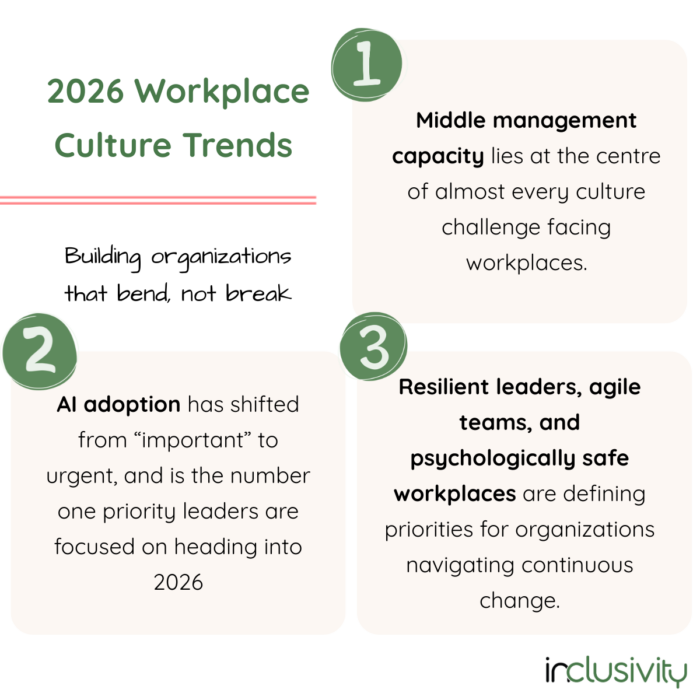
Three interconnected workplace culture trends emerged as defining priorities for the year ahead:
- Middle management capacity lies at the centre of almost every culture challenge facing workplaces.
- AI adoption has shifted from “important” to urgent, and is the number one priority leaders are focused on heading into 2026.
- Building resilient leaders, agile teams, and psychologically safe workplaces is becoming a defining priority for organizations navigating continuous change.
TREND #1: Middle management capacity lies at the centre of almost every culture challenge facing workplaces.
Middle managers sit at the centre of almost every workplace culture challenge organizations are navigating today.
98% of leaders said that middle management capacity is emerging as a top priority in 2026.
Leaders consistently identified middle managers as the most influential lever shaping execution, engagement, change adoption, and workplace culture consistency. Positioned between executive strategy and frontline reality, middle managers carry expanded scope and heightened accountability in increasingly complex conditions. Strengthening middle manager capacity is not simply a leadership development initiative. It is a structural imperative for strengthening workplace culture.
Many organizations talk about middle managers as culture carriers, but too often treat them as an afterthought in leadership development. In reality, middle managers play a critical role in shaping workplace culture, translating organizational values into everyday behaviors and team norms.
Research shows that middle managers need more than responsibility. They need meaningful, practical support aligned with the realities of their work. This includes:
- Real, practical development that builds skills they use today, not abstract frameworks disconnected from daily work
- Training embedded in workflow so learning happens in the context of real challenges and priorities
- Peer and cohort learning communities where middle managers share challenges, normalize vulnerability, and accelerate learning
- Coaching and reflection spaces where managers can practice giving feedback, resolving conflict, and leading through ambiguity
- Psychological safety for middle managers themselves so they can admit uncertainty, ask for help, and grow without fear of judgment
For many organizations, the path to a high-performing team runs through middle management capacity — the single most influential lever shaping culture today.
Trend #2. AI adoption has shifted from “important” to urgent, and is the number one priority leaders are focused on heading into 2026.
AI adoption has shifted from “important” to urgent, and is emerging as one of the most significant forces shaping workplace culture in 2026.
80% of leaders said AI implementation and change management are among the most important priorities emerging this year.
In our 2026 Workplace Culture research, AI emerged as the number one priority for CEOs and senior leaders heading into 2026. The conversation has shifted decisively and leaders are no longer debating whether AI should be integrated but are focused on how quickly and effectively it can be scaled to improve productivity, decision-making, and results in the workplace.
This urgency reflects growing competitive pressure. Organizations that move too slowly risk falling behind, while those that move too quickly without preparing their teams risk disruption from within. In this sense, AI adoption is not only a technology challenge, but a workplace culture challenge. Successful implementation depends on how well organizations support people through change.
Organizations that successfully integrate AI focus on both technical readiness and human readiness. This includes:
- Clear articulation of how AI supports strategy, performance, and workplace culture
- Practical training that builds real fluency, not surface familiarity
- Structured change communication that reduces uncertainty and builds trust
- Redesign of roles and workflows aligned with new capabilities
Organizations that approach AI transformation through both technology and workplace culture are far more likely to translate innovation into sustained performance.
Trend # 3. Building resilient leaders, agile teams, and psychologically safe workplaces is becoming a defining priority for organizations navigating continuous change.
As uncertainty becomes part of the everyday operating environment, organizations are reexamining the human capabilities required to sustain performance over time.
77% of leaders said this remains important or is becoming more important in 2026.
Resilient Leadership
In today’s workplace culture, resilient leadership has become a baseline expectation. It requires clarity, steadiness, and effectiveness while guiding teams through uncertainty and continuous change. For many organizations, strengthening resilient leadership has become a key focus of leadership development, particularly as leaders are asked to support both performance and wellbeing in complex environments.
The most effective leaders ground themselves in shared values, model inclusive behaviours, and create environments where people feel both safe and heard. In doing so, they shape the workplace culture their teams experience every day.
Several practices help translate resilient leadership into action:
- Anchor to Values: Remind employees that while perspectives may differ, shared values such as respect, dignity, and belonging remain the common ground.
- Set Clear Norms: Clarify expectations for respectful dialogue. Open expression does not include demeaning or devaluing colleagues.
- Model Inclusive Leadership: When leaders demonstrate curiosity, respect, and openness, teams tend to mirror those behaviours.
- Foster Psychological Safety: Encourage people to share perspectives while ensuring systems protect them from retaliation or marginalization.
- Equip Managers: Middle managers often carry the heaviest load when difficult conversations surface. Providing them with tools to mediate and guide dialogue is critical for sustaining a healthy workplace culture.
Agile Teams
At the team level, agility is emerging as a core performance capability for 2026. Agile teams are able to adjust priorities without losing alignment, experiment without losing accountability, and respond to change without fragmenting.
So what does agility look like in practice?
- Teams learn together. When people feel safe to challenge ideas, ask questions, and share feedback, teams adapt more quickly and make better decisions.
- Psychological safety supports adaptation. Teams that can raise concerns and admit mistakes early are better positioned to adjust course.
- Leadership reinforces the conditions. Leaders who provide clear direction while reinforcing trust and accountability help teams internalize agility as a sustainable way of working.
A Culture of Psychological Safety
Underpinning both leadership resilience and team agility is psychological safety. Leaders increasingly recognize that employees cannot adapt effectively if they feel uncertain, unsupported, or unsafe to speak up. This is why many organizations are investing in psychological safety training to help leaders and teams build the skills needed to support open dialogue and trust. Through psychological safety training, teams learn how to:
- Engage in healthy conflict
- Give and receive feedback effectively
- Resolve tension before it becomes corrosive
Moving Forward in 2026
Our 2026 Workplace Culture Research points to a clear shift: organizations are navigating sustained volatility, and performance will depend on how well structural, technological, and human capabilities align.
Three priorities stand out:
- Middle Manager Capacity: Workshops alone are not enough. Organizations need integrated leadership development that includes practical learning, coaching, real-time support, and peer learning communities.
- AI Implementation: Treat AI as both a technology and culture shift. Partner with experts who can support responsible adoption, change management, and workforce readiness.
- Resilience, Agility & Psychological Safety: Start with leadership commitment, then build a learning culture that strengthens inclusive leadership, growth mindset, and the ability to navigate healthy conflict.
Organizations that invest in these capabilities will be far better positioned to navigate uncertainty and sustain performance in the years ahead.
Turning Insight into Action
If you’d like to explore what these insights might mean for your organization, connect with us for a conversation.
This article is based on the webinar “2026 Workplace Culture Trends” hosted by Inclusivity in February 2026.